What are the politics of the undead? Are different monsters popular depending on which political party is in power? Prompted by this article, one of the panels I was on at Millennicon discussed that very question. Did your politics determine whether or not you liked zombies or vampires? Was it a real effect? Was it catharsis – going to see the things that scared you – or did it reflect the different natures of the monster types themselves? After all, vampires are emblematic of sexuality and (modern) zombies reflect the faceless horde of conformity… or do they?
The literary and cultural critiques were interesting, but I wanted to actually collect some real data (putting that sociology degree to some use, right?). So I ran an internet survey asking people their political preferences and monster preferences. It’s a convenience sample, mostly from the U.S. (This becomes important below.) If you’re not interested in the geeky stuff, skip down to the “discussion” section. Also, I’m relaunching the survey – please take five minutes or so to take the survey!
Politics
I tested for political preference in a number of ways. I asked respondents to identify what party they were registered with and which they identified with. These had a decent (and significant) correlation with each other (lambda(272)= 0.25; p=0.05). (Note to hard science people – a correlation of 0.25 is pretty decent for real-world observations in the social sciences, okay?) Likewise, the way someone identifies their political preference is somewhat predictive of party affiliation; at least for conservatives (lambda(268) = 0.174; p = 0.00) and liberals (lambda(268) = 0.18; p = 0.00). Moderates, however, had no significant relationship between identified preference and party affiliation (X^2 = 4.715, p=0.695). Reducing the attributes of “political party” to simply Republican, Democrat, and Other did not alter these in any meaningful way.
I also asked about attitudes toward social and economic issues.
With social issues, identifying as a conservative was predictive of attitudes (lambda(272) =0.135, p > 0.005), and likewise with liberals (lambda(272) =0.113, p=0.047). With economic issues, identifying as a conservative was predictive of attitudes (lambda(272) =0.236, p=0), and likewise with liberals (lambda(272) =0.315, p=0.0). Again, moderates had no significant correlation with their position towards social issues.
Determining position on economic issues identifying as a conservative was predictive of attitudes (lambda(272) =0.236, p=0) , as were liberals (lambda(272) =0.315, p=0.0), and moderates (lambda(272) =0.174, p=0.0).
There were significant – but somewhat weaker – relationship when social and economic issues were compared to registered and self-identified party. Correlating social issues by recoded party (lambda(268) =0.143, p=0) and considered party (lambda(267) =0.094, p=0.001); correlating economic issues by recoded party (lambda(268) =0.178, p=0) and considered party (lambda(267) =0.168, p=0.001)
All this indicates that indicated party registration is a predictor of political alignment, especially in the (at least surface) dual-party system in the US – but it does signify that the two-party system doesn’t necessarily fit the needs of people as much as the cons/lib/mod trinity (though it seems that moderate is shorthand for a catchall).
Because the relationships are stronger for self-identification as liberal/conservative/moderate, I chose to use that when examining for monster preferences.
Monsters
I examined the relationship between identified political alignment and monster preference using the Pearson Correlation (also known as the Pearson Product Moment Correlation). I did not find many significant correlations; to try to find more correlations I also recoded political preference into a “agree”/”disagree” binary.
There were few significant correlations between political alignment and monster preferences. A weak significant negative correlation was found between how conservative someone identified and how much they liked vampires (other than Twilight) ( -0.245, p = 0 ), aliens (-0.124, p = 0.041), constructs (-0.135, p = 0.027), and werewolves (-0.157, p = 0.01). A weak positive correlation was found between how liberal someone identified as and liking vampires (other than Twilight) ( +0.165, p=0.04 ); the recoded preferences only added a significant positive correlation to aliens (+ 0.148, p=0.015). Moderates were all over the map, with no significant correlations; N=271 in all cases.
Those who liked monsters, however, liked all monsters. This was true across nearly all categories of monsters.
Shortcomings
- I had a huge disparity in the percentage of liberal and conservative responses, which disappointed me somewhat.
- There were a lot of “monster” categories that I left out – some of the more common ones mentioned was the Cthulhu mythos, diakiju, and mythological and traditional monsters.
- There were many people complaining about the political classifications – but some said the categories were too broad, others that it was too narrow.
The biggest shortcoming was that I did not control for religion. Both faith tradition and strength of association with that religion was not asked about at all. I’m not sure if that would be a cause or an effect, but it wasn’t controlled for.
Discussion:
Politically, registration tended to follow basic two-party lines, though conservatives may have registered as independents or Republicans. When asked what party people identified with, the spread became quite a bit broader, with both liberals and conservatives identifying with parties other than the “big two” in the US. Moderates were all over the place; it almost seemed like “moderate” became a political catch-all. Because of this, I used self-identification as liberal, moderate, and conservative rather than party lines.
There were few significant correlations between political alignment and monster preferences. A weak significant correlation was found between how conservative someone identified and how much they liked vampires (other than Twilight), aliens, constructs, and werewolves. A weak positive correlation was found between how liberal someone identified as and liking vampires (other than Twilight) – and if I tortured the data a bit, aliens as well. Moderates were all over the map.
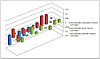
Graphing out all the correlations (even if nonsignificant) shows an interesting trend – liberals tended to like all types of monsters, and conservatives tended to not like all types of monsters. In line with that, liking one type of monster was a great predictor of liking all types of monsters. In fact, the association between liking vampires and liking zombies were pretty strongly positively correlated (0.506, p=0), blowing the original dichotomy between zombies and vampires out of the water.
Click the graphs to embiggen….


I’ve got a bit of a theory there. In general, conservatives tend to view the world as an inherently hostile place (à la Hobbes), where without control and a civilizing influence, people would descent into a violent anarchy. Likewise, liberals tend to view the world as a fundamentally peaceful (or at least, balanced) place, where mankind’s “natural state” is one where people live in a kind of harmony.
IF this model of thought is correct, then that makes a lot of things more understandable. If you generally feel safe, then feeling scared can become entertainment. If you generally think the world is a hostile place, then the last thing you want is to think about more things out to get you. Still, there’s a major shortcoming – as I mentioned, I didn’t ask about religion at all. So I’m relaunching the survey – if you’re in the United States, please click here to take the survey. It’s streamlined a bit, so it’s not quite the same as it was before.
Please share that url (https://bit.ly/monstersurvey ) with as many people as you can; the more responses, the better. Thanks!
Intriguing survey and I am interested in taking the updated version.
As a zombiephile who hangs out on a message board of writers in that genre, its interesting to see when politics pops up in discussions. As far as I can tell, they seem to attract people from both the left and the right. I am definitely entertained by other monster types as well, although I'm not involved in any other discussion groups on them. I'm very curious if one particular monster type actually draws a certain political crowd. It seems like fans of zombies, like the zombies themselves, come from all ends of the political spectrum.
I've run across a couple of different theories (and opinions) on that point. The data I have so far has some methodological issues, so that's why inviting people of all political stripes to this round is so important.